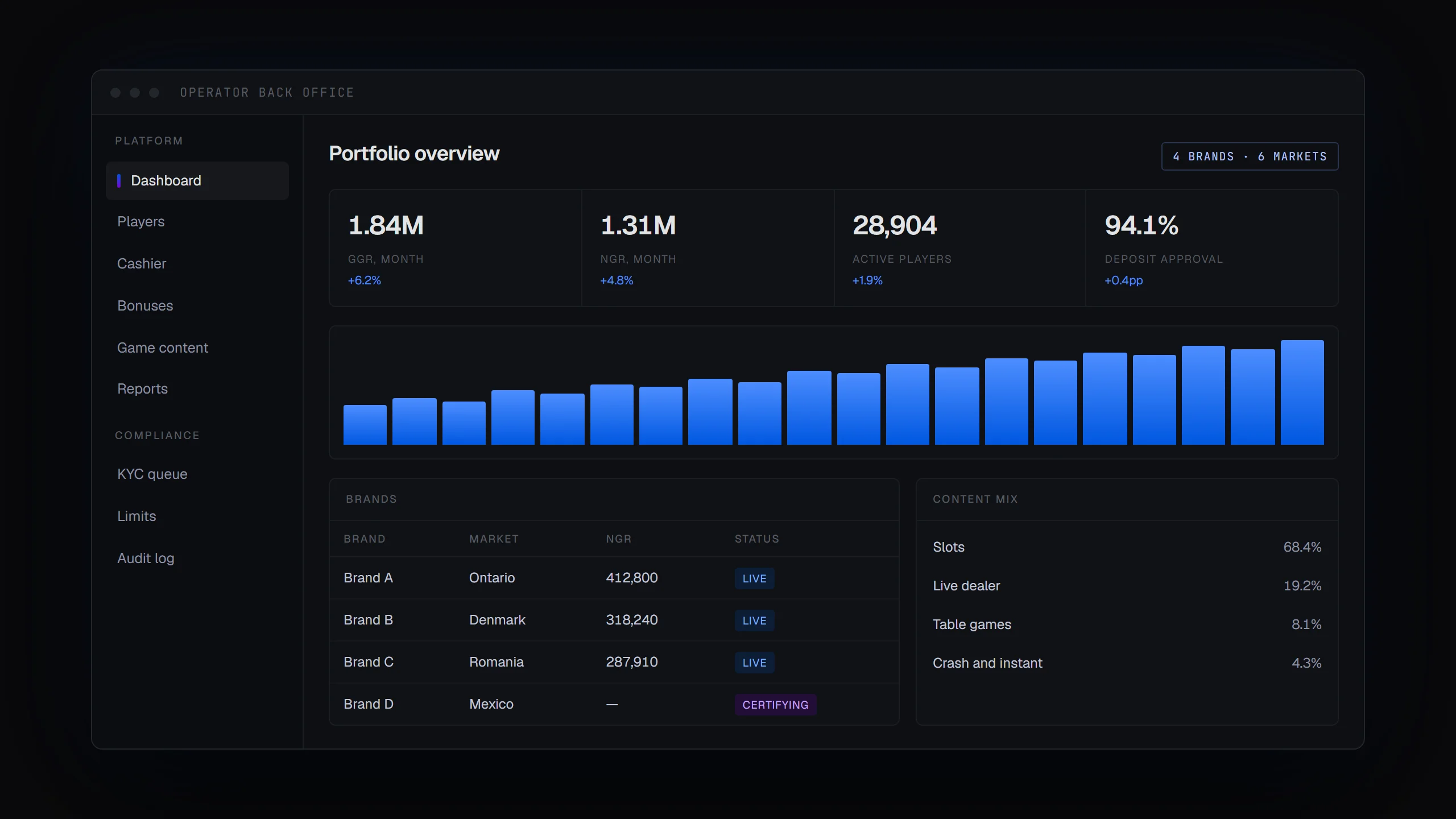
Our iGaming platform gives operators one stack for casino, sportsbook, payments, player management, bonusing and compliance behind a single API. Every module is production hardened, so you launch a branded site in weeks and add verticals later without re-platforming. It is written for the operator rather than the player: each capability maps to a commercial outcome such as NGR, retention or time-to-market. If casino is your only vertical today, the same core runs our online casino software and expands when you are ready.
Operators no longer buy a monolith. They assemble best-in-class components and expect them to behave as one product, with one wallet, one player record and one set of reports. That is the principle this iGaming platform is built on, and it is why a lean team can run several brands from a single back office.
Launch on the platform in three steps
- Plan the build. We map your target markets, licence status, content mix and payment needs, then open sandbox access in days so your team starts configuring immediately.
- Configure verticals and brand. You control themes, lobby, odds margins, bonus logic and languages through the CMS, with no engineering bottleneck between you and a live change.
- Go live and widen the offer. Launch in around 4 weeks, then switch on new verticals, currencies or jurisdictions as modules rather than as projects.
What our iGaming platform includes
The stack is modular. You run the components you need today and activate the rest as you grow, and every module shares the same wallet, player record and reporting layer.
- Game aggregation Connect 25,000+ slots, table games and live dealer titles from 100+ studios through game aggregation and a seamless wallet, so players move between titles without re-authenticating or losing balance. Certified live casino software is part of the catalogue, not a bolt-on.
- Payments Take deposits through 220+ methods in multiple fiat currencies and in crypto. Smart routing, automatic retries and reconciliation are part of the module rather than something you build, so approval rates rise and manual work falls away. See payments.
- Player accounts and wallet Registration, wallet, verification, KYC/AML and responsible-gaming controls sit in one place, so compliance is handled by design instead of patched in after an audit. See player account management.
- CRM and bonusing Segmentation, VIP tracks and a bonus engine that fires on real-time triggers turn retention into a rule set rather than a manual campaign calendar. See CRM & retention.
- Engagement mechanics Missions, tournaments, leaderboards and jackpots run on the same event stream as the rest of the stack, so every mechanic is measurable. See gamification.
- CMS and localisation Update content, promotions, banners and languages on your own schedule, and localise per market without waiting on a release cycle.
- Reporting and BI Cohort, LTV, GGR and NGR analytics sit behind every screen, so you optimise on data rather than instinct.
Because the iGaming platform is API-first, each module is also available to operators running someone else's core, and you keep full ownership of your player database at all times.
Casino and sportsbook on a single iGaming platform
Running two verticals on two vendors means two wallets, two player records and two versions of the truth in reporting. Here both verticals share one account, one balance and one bonus engine, so a player who bets on a match and then opens the lobby never sees a seam. The betting side brings pre-match and live markets, bet builder, cash out and risk tools; the full spec sits on sportsbook software. For the operator, the practical gain is one reconciliation, one compliance workflow and one cost base instead of two.
Dual launch is supported as well. Casino and sportsbook can go live together, or you can start with one vertical and add the other later without touching your player database.
Multi-brand and multi-market from one back office
Brands are a configuration, not a rebuild. A single iGaming platform deployment serves several brands, each with its own domain, design, game mix, bonus rules, currencies and jurisdiction settings, while your team works in one back office with shared reporting across the portfolio. Permissions are role based, so a market manager sees only their brand and the group sees everything.
That structure is what keeps operating cost flat as the portfolio grows. Adding a fourth brand or a fifth market is a configuration task measured in days, not a project measured in quarters.
iGaming platform, point solutions, turnkey or in-house build
Choosing among casino software providers and platform vendors comes down to speed, control and budget, and the criteria that actually separate platform vendors are worth settling before the first demo call. The table shows where a modular iGaming platform sits against the alternatives.
| Approach | Time to market | Control | Upfront cost | Best for |
|---|---|---|---|---|
| In-house build | 12–18 months | Full | Very high | Large groups with engineering teams |
| Point solutions stitched together | 6–12 months | High, but you own the integration | High | Teams with strong in-house tech |
| Modular iGaming platform (this page) | ~4–8 weeks | High, you own the platform and the data | Medium | Operators wanting speed with ownership |
| Turnkey casino | 2–4 weeks | Medium | Low | New entrants launching fast |
The difference between rows two and three is where the integration burden lives. With turnkey casino software or a modular platform it sits with the vendor; with point solutions it sits with you, permanently, including every provider upgrade.
Regulated-market readiness
The iGaming platform is built and tested to the standards applied in 20+ jurisdictions, including MGA, Curaçao, Ontario, Romania and Brazil, against GLI-tested RNG and ISO 27001 information-security standards, and configurable KYC, AML and responsible-gaming rules. Test-house evidence is produced at platform level, which keeps that burden off your team as you expand.
Rules are configurable per jurisdiction, so one deployment serves several regulated markets at once: deposit limits in one market, session controls in another, a different verification flow in a third, all from the same code base. Regulatory changes are shipped centrally, so you inherit them instead of scheduling them.
How the architecture fits your stack
The iGaming platform core is a single API surrounded by independent modules. One integration replaces a dozen separate contracts, and each part scales on its own under load.
- Casino
- Sportsbook
- Mobile
- Telegram
- One integration point
- Games
- Cashier
- Player accounts
- CRM
- CMS
- Reporting
- Game studios
- Payment providers
- KYC
- Regulator reporting
This is what lets a small team operate several brands at once, and why adding a vertical or a market later does not mean re-platforming. New components inherit the same wallet, compliance rules and reporting, so nothing is built twice.
Platform economics: what the stack does to the P&L
Good iGaming solutions are judged on the P&L, not on a feature list. Three levers matter most on any iGaming platform. First, time-to-market: weeks cut from the pre-launch schedule convert directly into weeks of NGR. Second, conversion and retention: higher payment approval rates, faster verification and real-time bonusing lift first-time deposits and repeat play. Third, cost of ownership: one integration and one back office replace a stack of separate contracts, so marginal cost per brand falls as the portfolio grows. The reporting layer ties the three together, showing GGR, bonus cost and NGR per cohort so you can see where margin is made or lost.
Migration from another platform
Switching to a new iGaming platform does not mean starting from zero. Player data, balances and history move in a staged cutover, integrations are re-pointed to the single API, and the front end is preserved or refreshed as you prefer. Most operators migrate to consolidate legacy contracts, cut operating cost and reach content or markets their previous provider could not.
Uptime, support and managed operations
Software is half of what keeps a brand live. Our iGaming platform is backed by 24/7 technical support, proactive monitoring and clear uptime SLAs, so incidents are handled before they reach players. Operators who prefer to stay lean can add managed services on the same stack: payment operations, KYC and verification, anti-fraud and multilingual player support. One named account manager owns the relationship from the first integration call onwards, and through every market you open afterwards, so your roadmap never lacks an owner.
Why operators choose this iGaming platform
- ~4-week launch to a live branded brand, casino or sportsbook or both
- 99.99% uptime under peak traffic, with horizontal scaling for spikes
- 25,000+ games and 220+ payment methods through one API
- 20+ jurisdictions we build for and configurable rules per market
- Modular by design: add a vertical, a brand or a market without re-platforming
- Full ownership of your player database, on every deployment model
For a new provider, the depth and clarity of the gaming platform you put in front of operators decide who makes the shortlist. That is the benchmark this page, and the product behind it, are written against.
Frequently asked questions
What is an iGaming platform?
It is the software an operator runs a real-money gambling business on: player accounts, wallet, game and odds content, payments, bonusing, compliance and reporting in one system.
What does an iGaming platform include?
Game aggregation and live casino, sportsbook, payments, PAM, CRM and bonusing, gamification, CMS, compliance and BI, all modular and sharing one wallet.
How fast can an iGaming platform go live?
Around 4 weeks for a modular launch, or 2–4 weeks for a turnkey package, depending on markets, licence status and content mix.
Can I run casino and sportsbook on one iGaming platform?
Yes. Both verticals share one player account, one balance, one bonus engine and one back office, and they can launch together or in sequence.
Do I need my own licence to launch on your iGaming platform?
For a full platform or turnkey deployment, yes. A white label runs under our licence instead, which is faster but gives you less control.
Does the iGaming platform support multiple brands?
Yes. One deployment runs several brands, each with its own domain, design, content, bonus rules and jurisdiction settings, managed from a single back office.
Can I integrate a single module into my existing system?
Yes. Our iGaming platform is API-first, so aggregation, payments, PAM or the sportsbook can run alongside your current core without replacing it.
How do you handle compliance across different markets?
Rules are configurable per jurisdiction on one deployment, with 20+ market-ready markets, GLI-tested RNG, ISO 27001 and full audit logs.
Who owns the player data on this platform?
You do, on every model except white label. The database is yours to export and migrate at any time.
Can I migrate from my current provider?
Yes. Players, balances and history move in a staged cutover with the front end preserved or refreshed.
See the platform on your own numbers
Tell us your target markets, verticals, licence status and budget, and our team will map the fastest compliant route to launch.