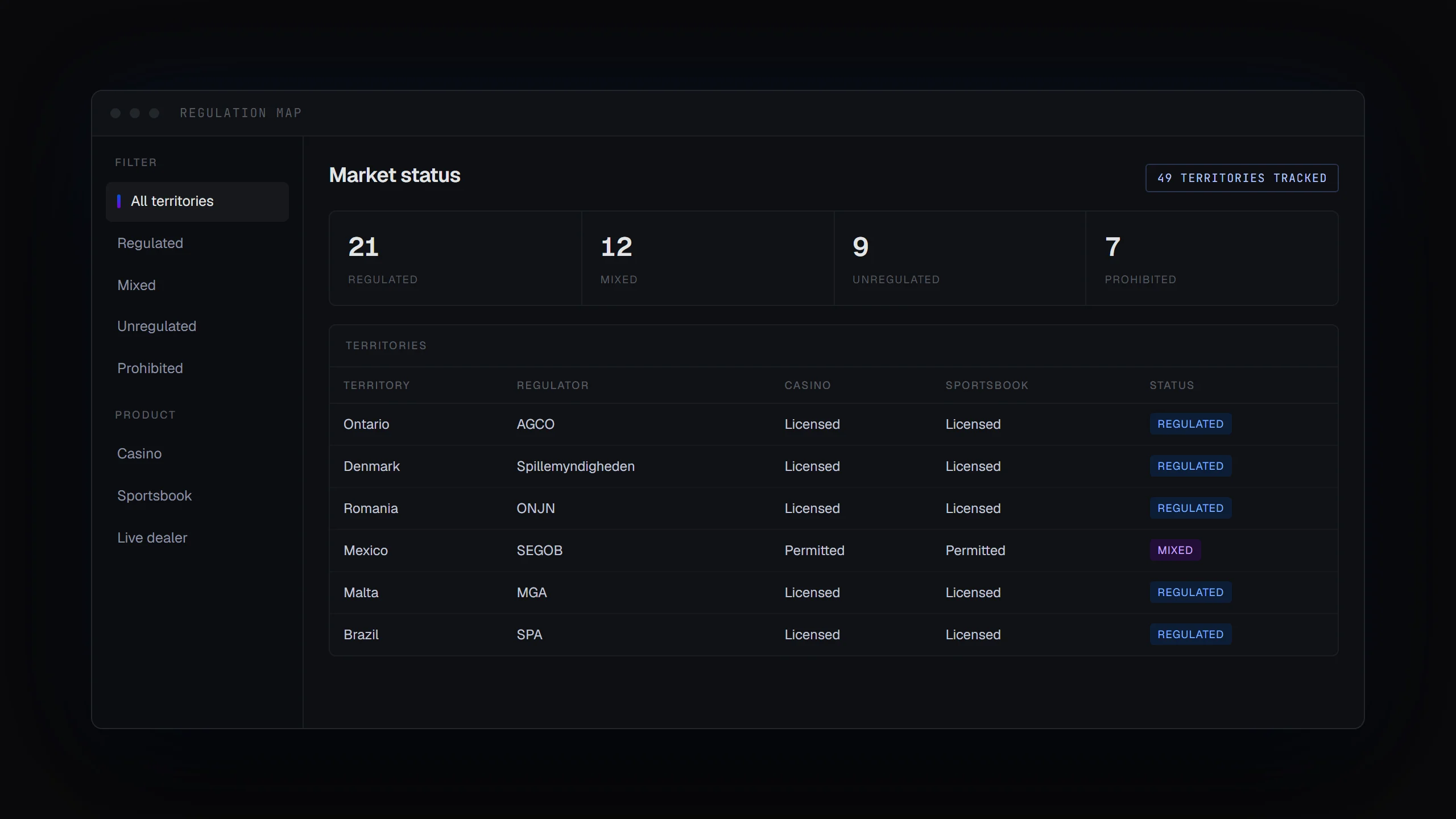
Market entry starts with two questions: are we allowed to operate there, and under which licence? This free map covers gambling regulation by country across roughly 49 markets, so you can read status, regulator and licence route before you commit budget to a territory. It is built for operators and compliance leads planning a launch, not players. Nothing is gated, no email wall, and any card can be cited or linked.
Regulation is rarely a single yes or no. A market can license sports betting while leaving online casino untouched, or license both yet restrict how you advertise. The map treats each gambling type as its own answer, because one national label is wrong more often than right.
Still choosing a first market rather than checking one? Our guide on how to start a casino covers the sequence, then bring a shortlist back here.
How to use the map
Map view colours the world by status, so you can scan a region and spot the clusters worth a closer look. Click any territory to open its card.
Table view is the same dataset as sortable rows, for shortlisting or comparing several markets rather than browsing.
Two filter groups drive both views. Filter by status to isolate every market at one maturity level. Filter by gambling type across casino, online casino, sports betting, online sports betting, lottery and bingo, because the answer moves with your product. Combine them to answer questions such as which markets license online sports betting.
How to read gambling regulation by country: the four statuses
The statuses are definitions, applied identically everywhere. Read them before the colours.
- Regulated A framework exists, a regulator issues licences for that gambling type, and a licensed operator may legally serve local players.
- Mixed Treatment is split. Some verticals are licensed and others are not, or authority sits with states and provinces rather than the national government. Federal markets are the common case.
- Unregulated No framework specifically permits or prohibits the activity. This is the grey market: not banned by statute, not licensed either, and open to change with little warning.
- Prohibited Law bans the activity, and enforcement can reach payments, advertising and site blocking, not just operators.
Status describes the market, not your risk appetite. Two operators can read the same card and reach opposite decisions, which is why we publish the framework, not a verdict.
What each country card shows
Every card carries the same fields, so markets stay comparable: status per gambling type, the regulator with a link to its own site, the local licence types, whether advertising is permitted, and the date the entry was last reviewed. Cards also flag our platform certification status where it applies, which matters once a shortlist becomes a launch plan. The modular casino software behind the platform is built and tested to the standards applied in 20+ jurisdictions. Treat each card as the start of diligence, not the end of it.
Accuracy, and what this map is not
This is a reference, not legal advice, and it creates no lawyer relationship. Gambling regulation by country moves constantly: statutes are amended, regulators reinterpret them, and a market can change category between one quarter and the next. Every entry is reviewed by our compliance team and stamped with a review date, so you can see how fresh it is.
Verify anything you plan to act on with the regulator itself, or with counsel licensed in that market. Where a card and a regulator disagree, the regulator is right.
Where to go next
Once a market clears your filter, the work turns practical: licensing, capital, local presence, payments and tax.
The Brazil launch guide goes a layer deeper for a single market, from licensing through payments and localisation, and further countries follow the same shape.
The compliance hub covers certification, KYC, AML and responsible gaming across the platform, including the markets we already hold.
Frequently asked questions
Is gambling legal in Mexico?
Open the Mexico card and read the status per gambling type: the honest answer for almost any market depends on the vertical and the date. We do not print a verdict here; the reviewed status sits on the card.
How do you get a gambling license in a given jurisdiction?
In outline: choose the jurisdiction, incorporate an accepted entity, pass fit and proper checks on owners and directors, submit an AML and responsible gaming business plan, certify your platform, then pay the fees. The regulator on each card publishes the binding list.
How to obtain a gambling license faster?
Most delay is self inflicted: incomplete ownership disclosure, unclear source of funds, certification started too late. Run platform certification in parallel with the application, not after it.
Which licence is fastest?
Offshore regimes are generally quicker than national ones, which is why a Curacao gambling licence is a common first step and a Kahnawake gambling licence suits region-focused operators. National licences take longer because scrutiny is heavier.
Which licence is cheapest?
Compare the cost of holding it, not the application fee. A gambling licence in Curacao looks cheap upfront, while the Malta gambling licence cost is higher but buys weight with banks. Gaming tax, capital and staffing usually outweigh both.
What is the difference between regulated and grey?
Regulated means a licence exists for your vertical and you can hold it. Grey means the law is silent: you are neither licensed nor clearly in breach, making it a commercial risk decision, not a compliance one.
How often is the map updated?
Entries are reviewed on a rolling schedule, and any market with active legislation is re-checked sooner. Each card shows its own last-reviewed date, not one site-wide claim.
Can I operate from an offshore licence into a regulated market?
Usually not. Once a market regulates, serving its players tends to require its own licence, and an external permit such as a Malta gambling licence does not extend to it. Check the card and local regulator first.
What changes when a market regulates?
A licence becomes mandatory, tax and reporting arrive, advertising rules tighten, and payment providers refuse unlicensed traffic. Incumbents either apply or exit, so the transition window is where market share moves.
Can I cite or link to this map?
Yes. It is free, ungated and built to be referenced, and a link back to the page or the country card is all we ask.
Plan your market entry
Use the map to narrow the list, then bring us the shortlist. Our team maps the fastest compliant route into each market you target, including national-licence launches where certification is in place.